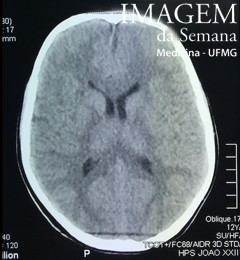
Medical history A 12-year-old male patient sought Emergency Care due to non-thermometrated fever, headache, irritability, prostration and photophobia with start 8 days ago. He has used azithromycin due to sinusitis for 5 days and denies comorbidities or allergies. The first exam showed: neck stiffness, positive Brudzinski and Kernig signs, AP: 100x60 mmHg, HR: 65 bpm. Performed lumbar puncture which cerebrospinal fluid examination revealed pleocytosis with a predominance of neutrophils, glucose at 45mg/dL and proteins at 105mg/dL. Treatment with ceftriaxone was initiated, but the patient subsequently developed 3 episodes of tonic-clonic seizures, papilledema, and loss of strength in the right lower limb. Computed tomography of the brain was requested for the propaedeutic extension. Image 1 - Computed tomography of the brain, axial cut, without contrast medium, level of the lateral ventricles (anterior and posterior horns).Image 2 - Computed tomography of the brain, axial section, without contrast medium, level of the 3rd ventricle.Image 3 - Computed tomography of the brain, axial section, after intravenous iodinated contrast medium, level of the lateral ventricles (anterior and posterior horns).Image 4 - Computed tomography of the brain, axial section, after intravenous iodinated contrast medium, level of the 3rd ventricle. Question:In view of the clinical picture presented and the changes observed in computed tomography, what is the most likely complication? Hygroma Subdural empyema Brain abscess Venous thrombosis None Time's up